War. Human made catastrophe of all catastrophes. Its black gloom shade mostly falls on people we can call ordinary, turning again and again in the life mirrors of generations for thousands of years, the indescribable terrifying slaughter that seems to be producing itself. And in the middle of this slaughter woman, who is regarded as being far away from the fight but as being in the front of leading life with the darkest loneliness, the impossibility of struggling for daily cares, days and nights wandering in a nightmare.
“The Girl with the Needle” is a film against war and about women and it also carries the hope of scattering the grey layers of clouds with love and the breath of open hearts. Even if pains we cannot escape are experienced, people can hold on to each other. Two people, hand in hand may look in the same direction, white horizons as the shadows go away. The wounds can be taken away from their nightmares with a fearless kiss and they can stretch to others with naturalness of sky freshness of mutual assistance. Those who can look into each other’s darkness bravely can be connected and connect in the smile of future.
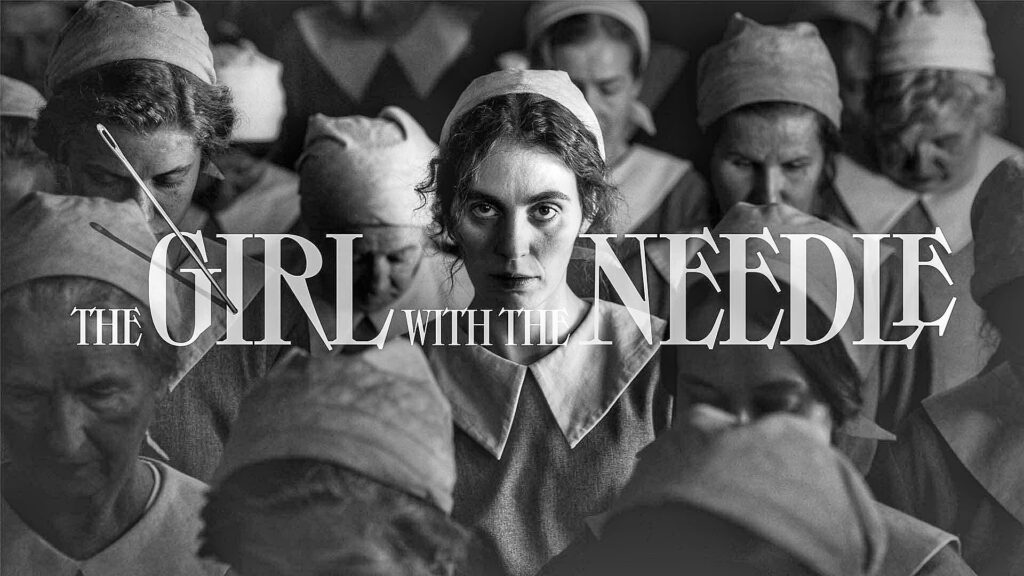
“The Girl with the Needle”, the film directed by Magnus von Horn in 2024 just directs this nightmare gloom mirror towards us. We enter the lightless paths with feeble steps. Denmark, 1919. Mourning houses, streets that misery stalks, people with faces that tell us what hopelessness means. The music of terrifying gray. The moments a person wanders around his/her utmost unknown parts. Can a human being be a monster, who is a monster, which person? Life, homelessness, children getting old early, indispensable choices that end in abyss, the desperate struggles of love? Love? Can the wings of love flutter towards hope even if war ends? When does war end really? The film that was selected to compete for the Palme d’Or at the 77th Cannes Film Festival leaves us alone with these terrible questions. It also competed for Best Foreign Language Film at the 82nd Golden Globe Awards and for Best International Feature Film at the 97th Academy Awards. The film is loosely adapted from Dogmar Overbye’s life story, a “serial killer” who lived at that time. Vic Carmen Sonne who acts as Karoline depicts a brilliant acting from her mimics to gestures, the tone of her voice to her looks. It is as if we live her story together in the film frames, shaking, sailing through the unknown waters of ourselves.
Karoline. Her husband is at war, no news of him, she cannot get widow’s allowance, either. She is in a very difficult situation economically. Even if she works at a factory, life conditions hardened by war are at unbearable dimensions. It seems there are no boundaries to misery, her way stretches from the terrible place she stays at to a worse one. The owner of the factory. A new hope, beam on the gray horizon. Love, that fluxing, indescribable spell, dream of dreams. Would that dreamy spell take a female worker to become a palace bride? Peter, her husband. His face behind the mask is the most horrible paragon of war. This miserable man has no place in this dream. His place is “outside”, like the war veteran of Wolfgang Borchert’s play “The Man Outside”. There is no belonging to come back for, is being alive breathing only, but breathe you have to, that rock is to be taken to the zenith, the body still struggles, despite the collapsed soul. We visualize Septimus Warren Smith, war veteran of Virginia Woolf’s “Mrs. Dalloway”, his waking up to war nightmare everyday, his being stuck to battlefields, ground on the violent gears of masculine order, his body stuck on the iron rails he threw himself from the heights, this is civilization. Karoline opens her eyes to a new nightmare, what she has thought as golden dust is just fake glitter. Without a job, with a little bit of money stuffed to her pocket, all alone with her baby in her belly full of life. We remember the girl in Annie Ernaux’s novel “Happening” whom she mentions in her “Cleaned Out” as well. The laws, prohibitions a woman faces when she is pregnant and does not know what to do with her baby, the silence on her condition, nothing in literature. She comes across Dogmar all of a sudden as she tries finding a way at the cost of her death. Dogmar owns a sweets shop. She says she gives children for adoption for a small payment, babies who their mothers do not know what to do with. This is a comradeship of three, Dogmar has an adopted daughter, too. They are in a tunnel with no visible end in dense loneliness. Morphine, sorrow expeller, even if it is for a very short time. There is female solidarity here, but it is in reverse.
The black and white film takes its magnificient pain, never-ending trials of humanity to our hearts from the screen with Frederikke Hoffmeier’s dark music as well. As having no colours throws us into a terrible whirlpool of existence, the music puts across the tension when the camera blurs the background to the inmost depths. The word monster, the question that who really the monster is or monsters are in our minds. The war sucks the blood of middling or poor people, throws them away by turning them into living ghosts. It makes them circus people, creatures wandering in the streets all alone, unable to enter their homes. The misery is at an indescribable dimension, there is no fear, only pain, the keenest one. We are in the scenes with our scream of goosebumps, Wilfred Owen’s poems full of war terror, “Dulce et Decorum Est.”
“If in some smothering dreams you too could pace
Behind the wagon that we flung him in,
And watch the white eyes writhing in his face,
His hanging face, like a devil’s sick of sin;
If you could hear, at every jolt, the blood
Come gargling from the froth-corrupted lungs,
Obscene as cancer, bitter as the cud
Of vile, incurable sores on innocent tongues”
The methods applied by women all around the world, married or single, young or old, the result of the pressure that children belong only to women, maybe a way out, needles, pins, some herbs, looking at the face of death, because a dark despair. The catharsis when a mass monstrosity is decreased to one person, a scapegoat is found. Is not the person who makes a woman miserable because she/he thinks of one as unworthy according to the rules of male domination or not to have a speck on his /her pseudo honour the description of the word monster?
“The Girl with the Needle” is a film against war and about women and it also carries the hope of scattering the grey layers of clouds with love and the breath of open hearts. Even if pains we cannot escape are experienced, people can hold on to each other. Two people, hand in hand may look in the same direction, white horizons as the shadows go away. The wounds can be taken away from their nightmares with a fearless kiss and they can stretch to others with naturalness of sky freshness of mutual assistance. Those who can look into each other’s darkness bravely can be connected and connect in the smile of future.